
Closets are where things go to be forgotten. Winter coats, shoe boxes, the vacuum, that bag of cords nobody can identify. They are also small, dark, closed up most of the day, and almost never get fresh air, which makes them a pretty comfortable place for mold when water gets in.
This post covers why closets grow mold, what we found in a bedroom closet in east Ventura after an HVAC leak, and how the plan for taking it out came together.
Why closets are a mold magnet
- No airflow. The door stays shut, so moisture that gets in has nowhere to go.
- Stuff packed against the walls. Clothes, boxes and bags trap damp air right against the drywall and hide the problem from view.
- Carpet and pad. They soak up water and hold it, and nobody pulls back the carpet in a closet to check.
- Equipment closets. Some closets are right next to, or share a wall with, the HVAC unit or water heater. If that equipment leaks, the closet next door is often the first place the water goes.
The EPA’s guide to mold and moisture recommends keeping indoor humidity below 60 percent, ideally between 30 and 50 percent, and keeping air conditioning drip pans clean and drain lines unobstructed and flowing properly. That second one matters a lot for a job like this.
What we found in a bedroom closet in east Ventura
The homeowner called because his HVAC system leaked and he now had a mold problem in a bedroom closet. The first visit was on September 21.
The closet floor
By the time we got there, the carpet in the closet was already out. The subfloor underneath had debris and dark spotting across it, heaviest near the walls. The bottom corner of one closet wall had dark spots too.
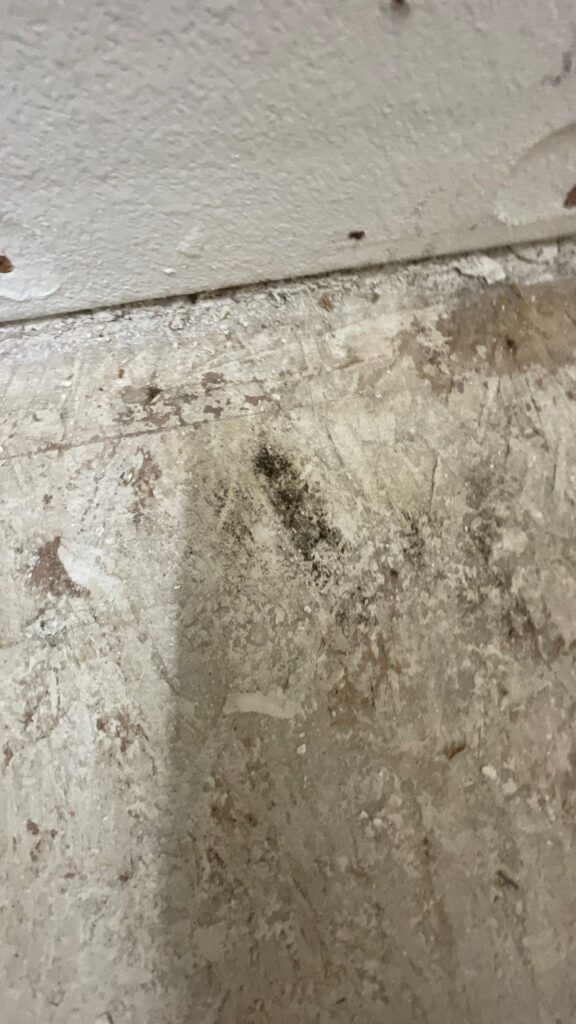
Readings were taken along the baseboards and on the subfloor all the way around the closet.
The plan, drawn right on the photos
One of our favorite things about how the crew documents a job is that the plan goes right on the pictures. In the bedroom closet, the markup says to remove the drywall 2 feet high around the bottom of the walls.

The HVAC unit sits on a raised platform in a separate closet. The markup there says the HVAC will be removed before the drywall comes out, the drywall will come out 1 foot high around that closet, and the plywood platform under the unit will be checked for growth.

Why the drywall comes out 1 or 2 feet, not the whole wall
Water from a leak like this runs along the floor and wicks up the bottom of the drywall. It does not usually climb to the ceiling. Cutting the bottom of the wall out takes the wet, moldy part, lets the framing behind it dry, and leaves the rest of the wall alone. How high the cut goes depends on how high the readings and the damage go, which is why it is 2 feet in one closet and 1 foot in the other.
The platform under the HVAC unit gets checked because it is right where a leaking unit drips. Plywood soaks up water and can grow mold on the underside where nobody looks. Our post on mold on a subfloor shows what that can look like once the flooring is up.
Signs of mold in a closet
- A musty smell when you open the door, even if everything looks fine
- Dark spots at the bottom of the walls or in the corners
- Carpet that feels damp, crunchy or stained near the walls
- Clothes, shoes or boxes on the floor that smell musty or have spots on them
- Peeling paint or a soft spot at the baseboard
- A closet that shares a wall with an HVAC unit, water heater or bathroom
If the closet backs up to a bathroom, our post on mold in the bathroom covers what to check on that side of the wall.
How an HVAC unit ends up leaking
Air conditioners pull water out of the air. That water collects in a drip pan and leaves through a drain line. When the line clogs or the pan cracks or overflows, the water goes wherever gravity takes it: into the platform, the floor and the walls around the unit. Our post on water damage from an air conditioner goes deeper on that.
What about the clothes?
Pull everything out of the closet first. The EPA’s guidance is to dry items completely, and it suggests talking to a specialist for valuable or sentimental items when you are not sure how to clean them. Anything absorbent that is actually moldy, like the closet carpet and pad, may have to be thrown away. We would rather tell you that now than have you find out from your favorite jacket.
Can you clean closet mold yourself?
A few small spots on a painted wall, maybe. The EPA says that if the moldy area is less than about 10 square feet, in most cases you can handle it yourself. But if the carpet was wet, the spots are at the bottom of the wall, or there is equipment in or next to the closet that leaked, the problem is almost always bigger than what you can see. That is when the drywall needs to come out. Our post on mold behind drywall explains why.
FAQ
Why does my closet smell musty?
Usually because something in there is damp: the carpet, the bottom of the wall, or the stuff stored against it. Closets have almost no airflow, so the smell builds up every time the door is closed.
Is mold in a closet dangerous?
The EPA notes that mold can cause allergic reactions in sensitive people and asthma attacks in people with asthma who are allergic to mold. Either way, it is a sign of a moisture problem that needs to be fixed.
How much does it cost to remove mold from a closet?
It depends on how much drywall and flooring has to come out and whether equipment has to be moved. Our post on mold remediation costs covers what drives the price.
Found mold in a closet?
Total Restoration handles mold remediation in Ventura and across Ventura County, Santa Barbara County and Santa Clarita. We find where the water came from, mark out exactly what needs to come out and take care of it. Contact us to get it checked.