
The homeowner in Agoura Hills thought the stain on the hallway ceiling was old. It had been there a while, he said. Small. Not spreading, as far as he could tell. Then the drywall let go, and what came down wasn’t from a roof or a pipe. It was condensate, the water an air conditioner pulls out of the air every hour it runs, and it had been feeding into that ceiling for most of the summer.
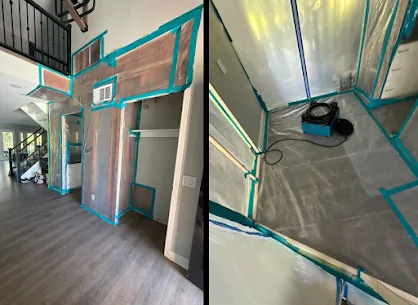
We documented that job in roughly 495 photos. Almost none of them are dramatic. That’s the whole problem.
Why water damage from an air conditioner hides so well
A working AC doesn’t only cool air. It dehumidifies it. On a hot Ventura County afternoon a typical system pulls several gallons of water out of your house in a day. That water has exactly one job: reach the condensate drain line and leave.
When the line clogs, whether from algae, dust, a wasp nest at the termination or a sagging run holding standing water, the water still has to go somewhere. It backs into the drain pan. The pan overflows. And because most air handlers around here sit in an attic or a closet above the living space, it goes down. Into insulation, ceiling drywall, and the top plates of your walls.
Nobody hears it. No burst, no rush of water, no wet floor at two in the morning. Just a slow feed, running all season.
The signs people walk past
- A ceiling stain that “isn’t spreading.” It is. Just slowly enough that you stopped noticing.
- A musty smell when the system kicks on. That’s air moving across wet insulation.
- A rusty drain pan, or water standing in it after a run cycle.
- Humidity that stays high even with the AC working hard.
- A float switch that keeps tripping. If your system shuts itself off and you reset it, that switch did its job. Stop resetting it.
- Cupped or lifting flooring directly below the air handler.
Why the slow leaks cost more than the fast ones
Counterintuitive, but we see it every summer. A burst supply line is loud and obvious and gets handled within the hour. A condensate leak gets handled in September.
The window is not vague. According to the EPA’s guidance on mold, moisture and your home, wet materials dried within 24 to 48 hours will, in most cases, not grow mold. Past that, you aren’t preventing anything. You’re remediating.
A condensate leak blew through that window back in June. So by the time a ceiling fails, we’re rarely just drying. We’re pulling insulation, cutting back saturated drywall, and checking whether growth moved into the wall cavity. That’s the gap between a straightforward water damage restoration job and one that also needs mold remediation, and the gap is usually just a few weeks of not knowing.
What to do the day you spot it
- Look at the ceiling under your air handler. Any discoloration, any sag, press gently.
- Find the drain line termination outside. On a hot day with the system running, it should be dripping. If it’s dry, something is wrong.
- If you find moisture, shut the system off. Running it keeps feeding the leak.
- Don’t paint over the stain. We can tell. So can your adjuster.
What shows up on a ceiling is the same story as the early signs of water damage anywhere else in the house, and it deserves the same urgency. Worth separating, though: this is a mechanical failure, which is not the same as condensation problems caused by the temperature difference between inside and out. Both leave you with moisture. Only one is a broken drain line.
FAQ
Is water damage from an air conditioner covered by insurance?
Often. A sudden, accidental discharge is typically covered. Long-term seepage frequently is not. Which side of that line you land on comes down to documentation and timing, which is why calling early matters more than people expect.
Can I just clear the drain line myself?
You can clear a clog. You can’t dry a wet ceiling with a shop vac. If materials are wet, that’s a separate job with different equipment.
How long has it been leaking?
Moisture mapping and staining patterns tell us more than most people think. We’ve dated leaks to within a couple of weeks.
Get eyes on it before the ceiling decides for you
Found a stain, a smell, or a pan full of water? Contact Total Restoration at (805) 410-4999. We inspect, we document everything, and we’ll tell you straight whether you need a dry-out or just a plumber. We cover Ventura County, Santa Barbara County and Santa Clarita, including Thousand Oaks and the surrounding cities.