
Everyone loves dogs. Fewer people love walking into a house after 25 of them lived there.
That was the situation at a home in east Ventura we walked through on October 28. The new owners were getting ready to move in, and the previous owner had kept 25 dogs in the house. Before they unpacked a single box, they wanted the place deep cleaned.
This post covers why dog urine smell is so stubborn, what the first walkthrough showed, and what it actually takes to get the smell out instead of covering it up.
Why dog urine smell does not just wipe away
Urine does not stay on the surface. It soaks into whatever it lands on, and in a house that means carpet, the pad underneath, the subfloor, baseboards, the bottom of the drywall and the grout between tiles. Once it dries, the smell is coming from inside those materials, not from the top of them.
A guide on removing pet odors and stains from the Humane Society of Sonoma County puts it plainly: if urine has soaked down into the padding underneath your carpet, the job gets more difficult. It also recommends a black light to find old stains, enzymatic cleaners from a pet supply store, and steering clear of strong smelling chemicals like ammonia or vinegar.
That last one surprises people. Covering a pet smell with another strong smell does not fix anything. The goal is to remove the source, not to make the house smell like vinegar and dog.
What the first walkthrough in east Ventura showed
The house was empty when we walked it. The photos from October 28 show the condition room by room before any cleaning started.
- Stains at the bottom of the walls. Dark marks and streaks along the lower part of the walls and door frames, right at dog height.
- Tile floors with dirt and staining in the main rooms and along the edges of the walls.
- Carpet in an upstairs loft that, like every carpet in a house like this, deserves a very suspicious look.
- Grime around doors, including the sliding door out to the back patio.
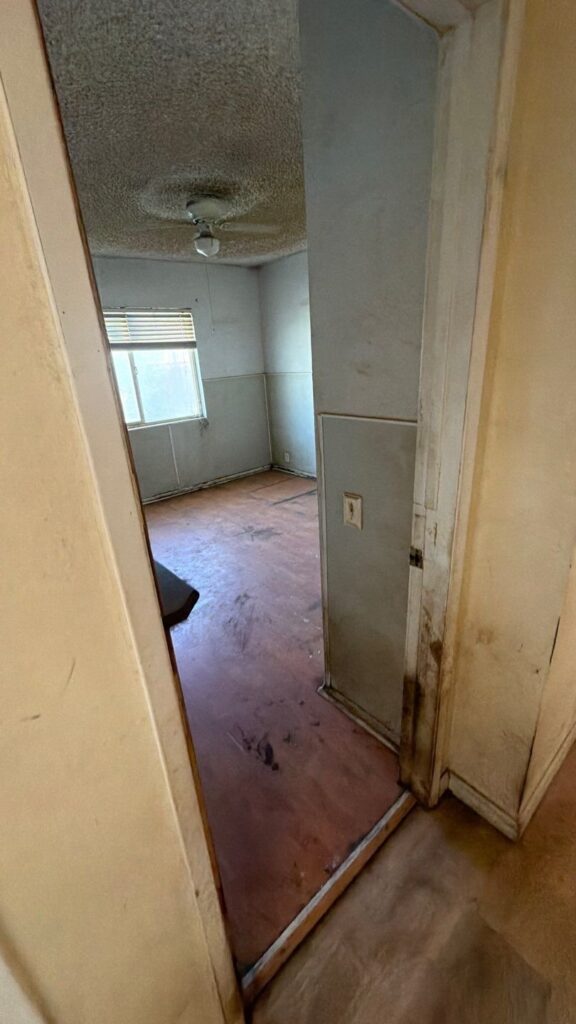

A walkthrough like this is where the plan comes from. Photographing the house room by room shows where the worst of it is and gives the new owners a record of the condition the house was in when they got it.
How to find where the smell is coming from
- Use a black light. Turn off the lights and go room by room. Old urine stains usually show up on carpet, baseboards and the bottom of walls.
- Check the corners. Dogs tend to go back to the same spots, often corners and along walls.
- Lift a corner of the carpet. If the pad or the subfloor underneath is stained, the smell is coming from there too.
- Smell the baseboards. Glamorous, we know. Painted wood and the drywall behind it soak up urine.
What it takes to actually get rid of dog smell in a house
- Find every spot. A black light and a walkthrough like the one above, room by room.
- Remove what cannot be saved. The Humane Society guide notes you may need to remove and replace the affected carpet and padding. In a house with years of heavy pet use, that is often most of it.
- Treat what stays. Subfloor, tile and grout get cleaned with products made to break down urine, not just mask it.
- Deal with the walls and trim. The same guide says that on floors and walls, you may need to remove and replace the layer of paint or varnish. Urine soaked baseboards sometimes just get replaced.
- Clear the air. Once the source is gone, the smell left in the air and on surfaces can finally clear out.
The order matters. Painting over a stained wall or putting new carpet over a soaked subfloor locks the smell in, and it tends to come back on the first warm day.
Bought a house that smells like pets?
Do the cleaning before you move in if you can. It is a lot easier to pull carpet, clean subfloors and repaint in an empty house than around your furniture. Take photos of the condition when you get the keys, too.
If the smell turns out to be musty instead of animal, that points to moisture, and our post on a musty smell in the house covers what to check. Our post on lingering odors and indoor air quality goes into why some smells never seem to leave.
When it is more than a cleaning job
Large amounts of urine and feces in a house are not just a smell problem. At that point it is closer to a biohazard cleanup, and the people doing it need the right protective gear and disposal. If urine has been soaking a subfloor for years, the wood itself may be damaged. Our post on what we find on subfloors shows how much can be hiding under flooring.
FAQ
Will dog urine smell ever go away on its own?
Not really. As long as the urine is in the carpet, pad, subfloor or walls, the smell keeps coming back, especially when it is warm or humid.
Can you get dog urine smell out of a subfloor?
Often, yes, once the carpet and pad are out and the subfloor can be treated directly. If the wood is badly soaked or damaged, that section may need to be replaced.
Do air fresheners or vinegar help?
They cover it for a bit. The Humane Society guide specifically recommends avoiding strong smelling cleaners like ammonia or vinegar. Remove the source instead.
Dealing with pet odor in a house?
Total Restoration handles odor removal and biohazard cleanup in Ventura and across Ventura County, Santa Barbara County and Santa Clarita. We walk the house, find where the smell is actually coming from and take care of it at the source. Contact us to get it looked at.