
Mold in a condo has a way of turning neighbors into opponents. Water shows up somewhere it shouldn’t, a few weeks pass before anyone calls for water damage restoration, and now there’s a musty smell, a soft spot in the drywall, and three parties quietly deciding it isn’t their problem. The unit owner points at the building. The HOA (Homeowners Association) points at the owner. Somebody remembers the upstairs neighbor had a leak last spring. And the question everyone is really asking, whether they say it out loud or not, is simple: who is responsible for mold in a condo when nobody wants the bill?
We got a close look at this recently. A Simi Valley HOA asked us to inspect one of its condo units after water damage had been reported in different areas of the property. We walked it, and we documented it. Thoroughly. By the time we were done, that single inspection lived in roughly 685 photos. There’s a reason we shoot that many, and we’ll get to it.
First, a plain-English tour of how responsibility usually gets split. This is general information from a restoration crew that has cleaned up a lot of these, not legal advice. Your CC&Rs (Covenants, Conditions, and Restrictions) and governing documents are the final word, so read them.
How responsibility for mold in a condo usually breaks down
Condos are strange animals. You own the air inside your walls, more or less, and the association owns a lot of what surrounds it. That division is where the fights start.
Most CC&Rs use some version of a “walls-in” or “studs-in” line. Here’s how that line usually falls:
- The owner is generally on the hook for the interior: paint, cabinets, flooring, fixtures, and personal belongings.
- The HOA is generally responsible for the structure and the common areas, which often includes the roof, exterior walls, and shared plumbing that runs between units.
- The master insurance policy covers the association’s side of that split.
- Your individual HO-6 (condominium unit owner insurance policy) covers your side.
Simple enough on paper. Water refuses to respect that line, though. It travels. A pinhole leak in a shared supply line behind a wall is usually an HOA matter, because that pipe serves the building. A busted hose under your own kitchen sink is usually yours. And a slow leak from the unit above you? Now you’re looking at a third party, and possibly their insurance, and the association is somewhere in the middle deciding whether the common-area plumbing had anything to do with it.
So the honest answer to who is responsible for mold in a condo is: it depends on where the water came from, and what your CC&Rs say about that spot. Those two facts decide almost everything. The mold itself is just the aftermath, and whether a unit ends up needing full mold remediation in Simi Valley or a quick dry-out, tracing the water is what points to the responsible party.
A few patterns we see over and over:
- Water from a common-area source, like roof flashing or a shared pipe, tends to land on the HOA and its master policy.
- Water from inside the unit, like an owner’s appliance or a fixture they installed, tends to land on the owner.
- Water from a neighboring unit tends to land on that neighbor, though the association still gets pulled in if any shared component was involved.
Notice the word “tends.” None of this is automatic. Some associations carry “bare walls” coverage that pushes more onto owners. Others carry “all-in” coverage that pulls more onto the master policy. The document on your shelf, not the pattern, is what governs your unit.
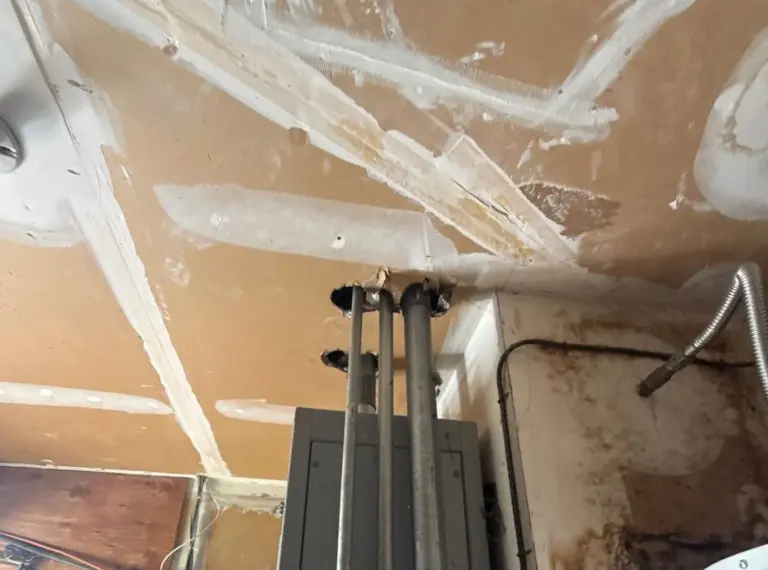
Why documentation decides who is responsible for mold in a condo
Here’s the part people skip. When three parties are pointing fingers, the finger that wins is usually the one attached to evidence.
That’s the whole reason a single condo inspection turned into hundreds of photos for us. When there’s mold in a condo and the money conversation starts, memory is worthless and opinions are cheap. What holds up is a dated visual record. When we walk a unit, we write down:
- What was wet, and how wet it was on the moisture meter.
- How far the moisture had spread past the visible stain.
- Which direction the damage traveled, so the source points back to a wall, a fixture, or a ceiling.
- The date on every photo, so nobody can argue the timeline later.
If the water came down through a shared wall, the photos show it. If it started at a fixture inside the unit, the photos show that too.
Good documentation does something quietly fair. It stops the loudest person from winning by volume:
- The owner can’t get blamed for a building problem.
- The HOA can’t get blamed for an owner’s dishwasher.
- The neighbor gets a straight answer instead of a rumor.
Everybody gets treated according to what actually happened, which, believe it or not, is what most reasonable people want once the shouting dies down.
It also protects the timeline. Mold doesn’t wait for a board meeting. The longer a wet cavity sits, the worse and pricier it gets, and a clear early record means our Simi Valley water damage crew can start drying while the responsibility question gets sorted in parallel. You don’t have to solve the blame before you stop the damage.
Why a fast professional inspection protects everyone
A restoration inspection isn’t about assigning guilt. It’s about facts, and facts happen to be the thing that protects the owner, the association, and the neighbor all at once.
We work with HOAs, property managers, and individual owners, and the reason we get called back is boring: we show up quickly, we find the moisture, and we write down everything. If a unit needs mold remediation, we handle it. If the real issue is active water damage that hasn’t fully dried, we handle that too, because drying the source is how you keep the mold from coming back next season.
Being local matters here. We’re a family-run crew that knows Simi Valley and the surrounding Ventura County properties, so we’re not driving in from three counties away while a wall gets worse.
FAQ (Frequently Asked Questions)
Who pays for mold in a condo, the owner or the HOA? It depends on where the water started and what your CC&Rs say. Common-area sources usually fall to the HOA and its master policy, while interior sources usually fall to the owner. Read your governing documents to confirm your unit’s split.
Does my HOA’s master insurance cover mold in my unit? Sometimes, partly. Master policies vary from “bare walls” to “all-in,” which changes how much lands on you versus the association. Check your policy and your HO-6, and don’t assume either one covers mold without reading it.
What should I do first when I find mold after a leak? Take these steps in order:
- Stop the water if you can safely reach the source.
- Get the damage documented with dated photos before anyone starts cleaning.
- Read your CC&Rs to see which side of the walls-in line the source sits on.
- Call a restoration crew so drying starts while the responsibility question gets sorted.
An early dated record protects you no matter which way the responsibility question lands.
Get It Looked At Before It Spreads
Found water where it shouldn’t be? Contact Total Restoration. We inspect, we document everything, and we work fairly with owners, property managers, and boards alike.
Share
Lorem ipsum dolor sit amet, consectetur adipiscing elit. Ut elit tellus, luctus nec ullamcorper mattis, pulvinar dapibus leo.